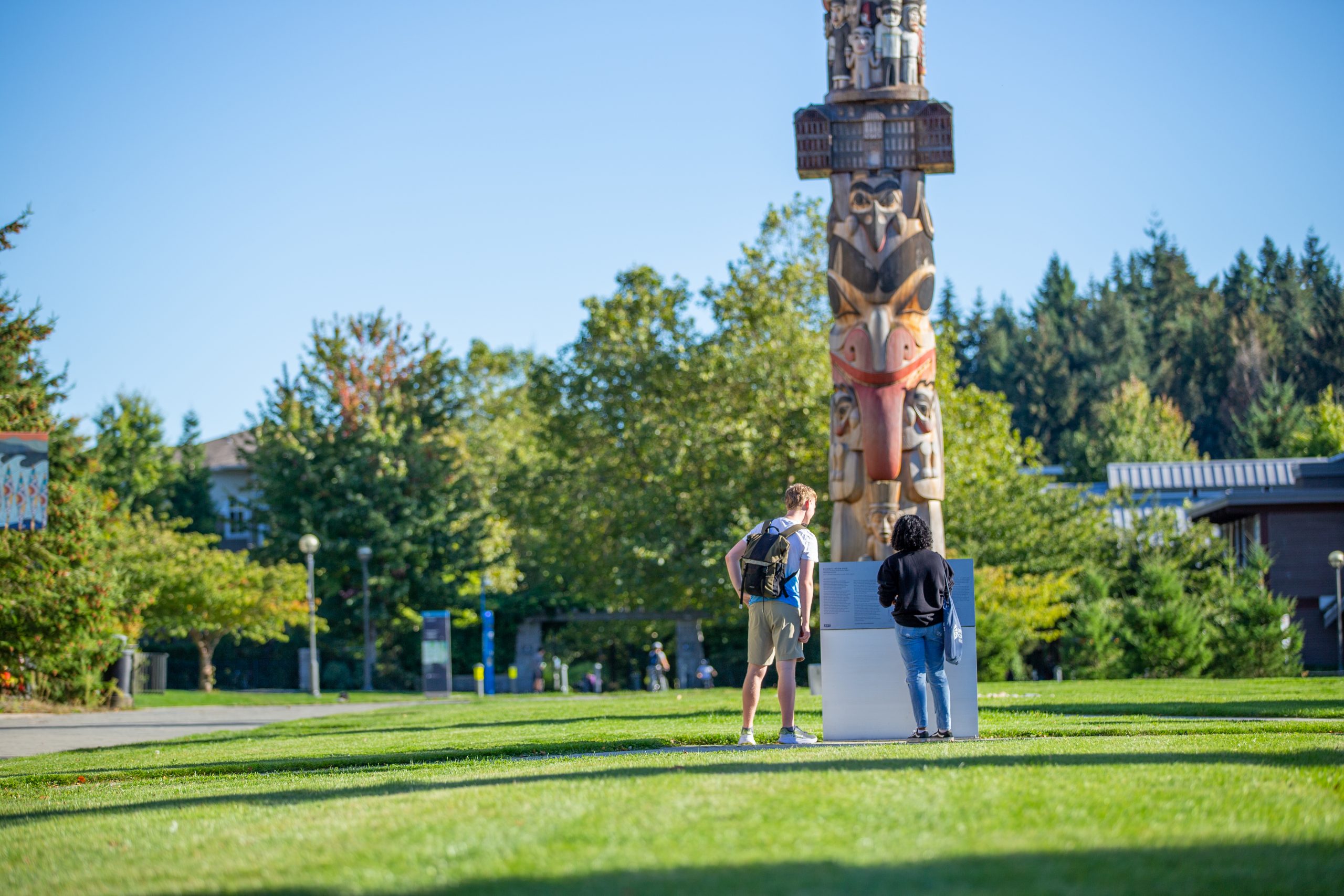
How is the Indigenous Health Administration and Leadership Program Delivered?
How is the Indigenous Health Administration and Leadership Program Delivered?
This one-year, part-time certificate program is delivered in-person and online, combining self-study with real-time online learning opportunities.
The program consists of weekly online real-time classes, peer learning and group discussions. Two of the five courses include a mandatory 3-day (Thursday to Saturday) in-person learning session at the UBC Vancouver campus. The final in-person learning session at the end of the program takes place Thursday to Friday and includes a community immersion experience and graduation ceremony. In addition to the instructor-facilitated classes, students complete written assignments based on readings and personal experience using an online discussion board.
Instructors create a safe, supportive and engaging in-person and online learning environment grounded in Indigenous approaches to learning. This includes circles, small group discussions, and lectures with plenty of time to learn concepts, ask questions, practice, and apply learning to your community.
Overview of Each Course
The program comprises five courses. Course modules provide opportunities to practice critical thinking and team-building, as well as to develop oral, written and electronic communication skills for organizational and interpersonal settings. The order in which courses are offered is subject to change.
Communication and Leadership course:
- Create a personal definition and understanding of leadership that reflects your cultural values and collective ways of being and leading
- Identify competencies and approaches supportive to facilitating change management
- Cultivate inspired teams who are uplifted by their personal and collective work
- Foster healthy workplace environments
- Find solutions to challenges and problems
- Enhance written and verbal communication with colleagues, leadership, partners, Elders, and community members
Fundamentals of Administration:
- Strengthen understanding of health governance in First Nations structures and complex organizations and culturally relevant community health programs
- Cultivate enhanced knowledge about community/citizen engagement, health care planning and implementation of innovation/best or wise practices and quality improvement
- Understand strategic planning and implementation, including introduction to systems thinking perspectives and processes of program and project management
- Explore key areas of health organization or health system management. For example, human resource management, including performance reviews and management, organizational/health system perspectives of professionalism and codes of conduct; and, financial/accounting considerations, program funding and reporting.
Evaluation, Research, and Policy
- Compare and contrast types of knowledge
- Create a plan to evaluate a program or service according to Indigenous approaches and ways of knowing
- Critique a research project, in relation to its fit for your community
- Describe the various ways that policy shows up in our lives
- Develop a draft policy for your workplace or community
- Analyze public policy and their impact on Indigenous peoples
Information Management:
- Analyze the ethical and legal issues in health management (e.g., privacy, confidentiality, data ownership)
- Analyze the benefits and pitfalls of technology from a personal, organizational and community perspective
- Assess the opportunities and benefits of implementing technology solutions in their organizations using a project management approach
- Describe the key characteristics and concepts of community Information Management
- Apply the principles of evidence informed decision-making to the planning of technology use in a community environment
Indigenous Health and Wellness:
- Examine historical and current impacts on Indigenous people’s health and wellness including the social determinants of health
- Explain Indigenous concepts of health and wellbeing and traditional healing approaches
- Determine strength-based approaches to mental health and wellness
- Embrace Indigenous harm reduction principles
- Design effective Indigenous health and wellness programming incorporating best practices in Indigenous health programming
Meet your Instructors and Peer Mentor
Be guided by Indigenous educators and professionals who bring their education, community, and work experience into the class room
Lauren Brown, BSN, MA, from the Haida Nation
Lauren Brown, BSN, MA, from the Haida Nation is an advocate for improving Aboriginal health, and has experience in policy and program development, teaching and government relations. She has worked in various provincial organizations, including Chief’s Committee of Health and Healing Our Spirit, and in patient advocacy at BC Women’s, BC Children’s and St. Paul’s hospitals. Lauren served for seven years on the board of the First Nations Health Directors Association, and more recently on the board of the Minister’s Advisory Council on Indigenous Women.
In 2003, Lauren moved to the Haida Nation community in Skidegate, BC to assume the role of health director at Skidegate Health Center. Though challenging, this fulfilling role allows Lauren to influence positive changes in health in her community.
The proud mother of two girls, Lauren is committed to learning the Haida language, Xaayda K’il. She holds a bachelor of science in nursing from UBC and earned a Master of Arts in Leadership – Health from Royal Roads University.
Danielle Mitchell, MA, is Nehiyaw/Metis and of mixed European ancestry with connections to Muskeg Lakes nd Cree Nation and Duck Lake area within
Danielle was born, raised and continues to be a grateful guest on the unceded lands of the Halkomelem speaking peoples, including Qayqayt, xʷməθkwəy̓əm (Musqueam), Skwxwú7mesh (Squamish), and Səl ̓ ílwətaʔ/ Selilwitulh (Tsleil-Waututh) Nations.
Danielle has over 13 years of experience in the health and social services sector within Indigenous Health, Human Resources and Financial Services. Working in senior leadership, Danielle’s focus was to advance structural and systemic changes, and address anti-Indigenous racism through strategy, practice and policy. In her consultancy business, Danielle works from a rights-based Indigenous lens to uplift perspectives of Indigenous communities, knowledge systems and collective ways of being and leading. She partners with public and private organizations to strengthen their capacities and take action toward meaningful relationships and change.
Danielle completed a Master of Arts in Leadership degree from Royal Roads University (BC) and has an educational background in systems transformation, business management, human resources and project management.
To most, Danielle is known as auntie, sister, daughter, cousin and friend.
June Kaminski, BSc, MSc, has maternal blood ties to the Ketegaunseebee Anishnabai, Garden River First Nation
June Kaminski, BSc, MSc, has maternal blood ties to the Ketegaunseebee Anishnabai, Garden River First Nation, in Northern Ontario. She has taught many programs related to nursing, research, and Aboriginal health and education over the past 23 years. She recently won the Canadian Association of Schools of Nursing (CASN) Nursing Faculty e-health Award and is also the Editor-in-Chief of the Canadian Journal of Nursing Informatics. June is working towards her PhD in Curriculum and Pedagogy Studies.
Len Pierre, M.Ed, Katzie First Nation
Len Pierre is Coast Salish from Katzie (kate-zee) First Nation. Len is an award winning entrepreneur, professor, consultant, TEDx Speaker, social activist, change agent, & traditional knowledge sharer. He specializes in the development of educational programs and services with decolonization and reconciliation as its core values. Len holds a Masters degree in Education from Simon Fraser University focusing on Indigenous curriculum and instructional design. His experience includes Indigenous education and program leadership from various organizations across colonial Canada. He comes to us with an open heart and open mind, and hopes to be received in the same way.
Melanie Rivers, Tiyaltelwet, BA, PID, MPH, EXAT, is from the Squamish First Nation
Melanie Rivers (Tiyaltelwet), BA, PID, MPH, EXAT is Coast Salish from the Squamish Nation. She develops curriculum for Indigenous programming with the UBC Centre for Excellence in Indigenous Health, and is a Community Expressive Arts consultant.
Melanie has more than 25 years’ experience in the design and delivery of culturally appropriate Indigenous health education and policy at the provincial level. She was program lead and educator at the BC Centre for Disease Control Chee Mamuk program, and worked as a senior policy advisor at the First Nations Health Authority. Her areas of focus have included cultural safety and humility, harm reduction, traditional healing and wellness, strategic policy development, HIV/AIDS and health human resources.
In addition to her degrees, Melanie holds a provincial instructor’s diploma from Vancouver Community College, and trained as an Expressive Arts Therapist at the Vancouver School of Healing Arts.
Reciprocal Consulting Inc. (RCI) is an award-winning majority Indigenous-owned and operated research, evaluation, education, and consultation firm that specializes in working with First Nations, Metis, and Inuit organizations and communities. Their team has academic, professional, and community-based experience. Their approach is grounded in Indigenous worldviews, cultural relevance and responsiveness, participatory methods, developmental approaches, and social justice and equity. Along with research, evaluation, and education, they provide reconciliation action planning and advisory services and mentorship.
Your Peer Mentor: The IHALP Peer Mentor is an alumni of the program. They support the students throughout the program and host weekly virtual “Tea with Your Peer Mentor” on Friday mornings.
Garrity Reese has completed the IHALP program in the 2023/2024 cohort as a student and has since participated as the IHALP peer mentor for 2024/2025 and again in our upcoming 2025/2026 cohort. She’s found the program to be one of her most cherished and connecting learning experiences both as a student and as peer mentor. Garrity’s ancestry is both settler and Indigenous heritage with mixed European and Coast Salish on her mother’s side coming from Boston Bar B.C., Nlaka’pamux. She lives and works on the unceded ancestral land of Semiahmoo. Alongside her work with IHALP, she currently works as a student counsellor and as department chair with Kwantlen Polytechnic University.
How Will I Know How I’m Doing?
Assessment criteria is developed to support Indigenous learners and reflect their ways of knowing and seeing.
- Participants are assessed according to clear guidelines to support participants in acquiring the skills and concepts taught in the program.
- Assessment is based on participation, weekly online group discussions, assignments, presentations, and projects.
- Instructors and program staff will guide your learning along the way.
What Technology Do I Need?
We recommend that you have the following technology requirements to keep up with the program and complete projects and assignments online:
- Laptop or desktop with Windows 10 or Mac OSX Sierra 10.12 or higher (we highly recommend a desktop and ethernet cable)
- Keyboard and mouse
- Speakers and a microphone – built-in, USB plug-in, or wireless Bluetooth
- A webcam or HD webcam – built-in, USB plug-in:
- Stable internet connection – broadband wired or wireless (minimum 3G or 4G/LTE)
- Familiarity with basic internet applications (email and web browser)
A week before the program start, we hold a mandatory online orientation that prepares and supports you for the program.
Please also subscribe to UBC Extended Learning News and Updates to receive new course announcements and program updates.
Related Links
Stay in the loop!
Be sure to stay in touch with us via our newsletter to get up to date news on CEIH programming, course offerings and more!